

Summary
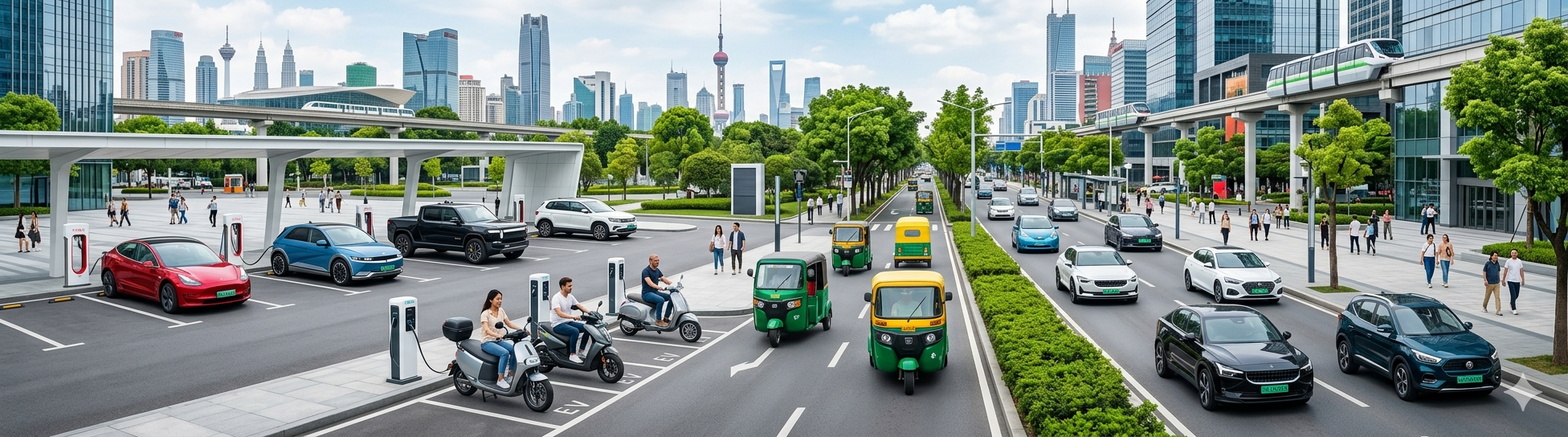
EV commentary has been largely dominated by the passenger four wheeler side. Yet, beyond the US and Western Europe, a world of EV opportunities continues to generate momentum.
The global electric vehicle market achieved unprecedented scale in 2025, surpassing 20.7 million units sold across all vehicle segments, a 20% YoY increase. It would be easy to assume that passenger vehicles continue to drive this. Yet, our market insights reveal fundamentally distinct market structures driven by economic development levels, urban mobility patterns, policy frameworks, and infrastructure maturity. This creates distinct opportunities for EV OEMs, some of which will continue to grow sans government incentives for consumers.
Our findings demonstrate that developed markets concentrate overwhelmingly on passenger vehicles (>95% share), while emerging Asian economies exhibit diversified portfolios with significant 2W and 3W penetration serving last-mile connectivity and affordability imperatives. China maintains absolute dominance at 12.9 million units, though India’s 2.36 million units represent the world’s most heterogeneous vehicle-type distribution. Understanding these market insights helps stakeholders identify where real growth opportunities lie beyond traditional passenger vehicle segments.
Global EV Sales: Top Countries by Volume (2025)
China: Passenger Vehicle Dominance with Legacy 2W Leadership
China’s 12.9 million EV sales in 2025 reflect a maturing market transitioning from two-wheeler saturation toward passenger vehicle sophistication. The passenger segment now comprises 87.6% of China’s EV market value despite lower unit share, driven by premium SUV and sedan ASPs exceeding USD 30,000.
Two-wheeler sales, though still substantial at 6 million units, represent market contraction from the 2021 peak of 11 million as Chinese cities enforce stricter registration controls and consumers upgrade to four-wheel mobility. Sub-400W e-bikes retain 76.65% unit share due to license-free operation, while premium 5kW motorcycles grow at 4.29% CAGR among performance enthusiasts.
Commercial EVs benefit from municipal zero-emission mandates and battery-swap infrastructure for logistics fleets.
Comprehensive country insights help OEMs understand how China’s market evolution differs from other Asian economies.
India: The World’s Most Diversified EV Ecosystem
India’s 2.36 million EV sales in 2025 represent the most heterogeneous vehicle-type portfolio globally, reflecting acute affordability constraints, dense urbanization, and last-mile delivery economics.
High-speed electric two-wheelers led at 1.35 million units, though growth moderated amid GST-2.0 tax adjustments that reduced ICE-2W price differentials and dampened conversion momentum.
Three-wheelers emerged as the breakout category with 800k units sold (+38% YoY), achieving 31.8% EV penetration – the highest electrification rate across all Indian vehicle segments.
Passenger vehicles reached 177K units (+77% YoY), demonstrating explosive growth from a low base as Tata Motors, Mahindra Electric, and MG Motor target aspirational middle-class buyers with USD 15,000 – USD 25,000 compact SUVs.
Commercial vehicles remain nascent but concentrate in urban e-bus fleets. Accessing comprehensive country insights on India’s multi-segment EV landscape helps OEMs and suppliers identify which vehicle categories offer the fastest path to scale.
US: Passenger-Only Market with Fleet CV Emergence
The United States EVs are overwhelmingly concentrated in passenger vehicles (1.58 million units) with negligible 2W/3W presence due to highway-centric transportation culture and absence of urban micro-mobility traditions. Tesla maintained market leadership despite intensifying competition from Ford (F-150 Lightning), GM (Ultium platform), and Hyundai-Kia’s IONIQ/EV6 families.
Commercial EV sales (~20K units) center on last-mile delivery vans (Amazon Rivian fleet, FedEx E-Transit) and refuse trucks, driven by corporate ESG commitments and total-cost-of-ownership advantages in high-utilization applications. Class 8 electric trucks remain sub-1% penetration due to range/payload constraints. Market intelligence suggests this segment requires battery technology breakthroughs before meaningful adoption.
Germany: Europe’s Passenger EV Leader with LCV Growth
Germany’s EV growth (+41% YoY till November 2025) was driven by reinstated purchase incentives and accelerated OEM electrification roadmaps (VW ID series, Mercedes EQ, BMW i). Germany reached a milestone of >2 million BEVs on road in 2026, a development tracked closely by market research firms analyzing European EV trends.
Though lagging some of its EU countries in pure EVs, the growth trajectory is expected to get a fillip from the EUR 3 billion government-funded EV incentive scheme to be operational in 2026.
Light commercial vehicles grow faster than passengers as logistics operators electrify urban delivery fleets to comply with city-center emission zones (Berlin, Hamburg, Munich).
European Markets (UK, France, Norway, Sweden, Italy, Netherlands, Spain, Belgium): Passenger-Centric with ZEV Mandates
Western European markets collectively sold ~1.6 million EVs in 2025, uniformly concentrated in passenger vehicles due to mature automotive cultures, extensive charging infrastructure (400,000+ public chargers EU-wide), and stringent CO2 fleet regulations (95g/km targets).
These regulatory frameworks create distinct opportunities that require detailed market insights to navigate effectively.
UK and France demonstrate ZEV mandate impacts: OEMs must achieve 22% EV sales in 2024, rising to 80% by 2030, or face penalties of EUR 15K per non-compliant vehicle. Commercial EVs (aggregated ~65,000 units) concentrate in urban delivery vans (DHL, DPD) and municipal fleets.
Thailand: ASEAN’s EV Manufacturing Hub with 2W Momentum
Thailand stands as Southeast Asia’s electrification leader, holding >50% of ASEAN EV market share. The EV3.5 incentive program combines consumer subsidies with local-content mandates, catalyzing investments from BYD, Great Wall Motors, and SAIC to establish Thailand as “Detroit of Asia” for EVs.
Passenger vehicle sales surged 40% YoY as buyers accessed subsidies up to THB 150K (USD 4,200). Two-wheeler sales lead ASEAN in volume, driven by affordable Chinese imports priced under USD 1,000 and urban commuters seeking license-free mobility. Three-wheelers concentrate in tourist areas (Phuket, Pattaya) as eco-friendly tuk-tuk alternatives. Key account intelligence on tourism operators reveals strong demand for electric fleet conversions.
Vietnam: 2W Electrification at Scale
Vietnam’s EV sales exhibit extreme two-wheeler concentration, reflecting the nation’s status as the world’s fourth-largest motorcycle market. 2W adoption continues to benefit from urban congestion-zone exemptions in Hanoi/Ho Chi Minh City, low-interest loans and battery-swap networks in major cities.
Passenger vehicles remain nascent but grow from VinFast’s aggressive local-market push and government import-duty waivers for EVs under USD 40K. Client insights from regional distributors indicate growing middle-class interest in affordable EVs.
Indonesia: 2W Market with Nascent PV Adoption
Indonesia’s EV sales mirror Vietnam’s 2W concentration, driven by cheap Chinese imports and government subsidies for motorcycles under 3kW. Jakarta’s traffic congestion and fuel-subsidy reductions accelerate two-wheel electrification.
Passenger vehicles grow slowly despite Hyundai and Wuling investments, constrained by limited charging infrastructure outside Jakarta-Surabaya corridor. Partnering with a market research firm can help OEMs navigate Indonesia’s complex regulatory landscape and infrastructure gaps.
Key Takeaways
Based on comprehensive market insights across these diverse markets, several critical patterns emerge:
- GDP per capita dictates the type of EV adoption. Lower per capita nations (India, Vietnam, Indonesia, Thailand) are dominated by two/three-wheelers, optimizing affordability and urban maneuverability. As income rises substantially, household car ownership tends to rise.
- Direct purchase incentives (Norway’s tax exemptions, Thailand’s EV3.5, IRA credits) continue to be a major factor in driving EV adoption across types. Demand has suffered in absence of incentives as is evident in the US and other Asian economies.
- Commercial EVs represent 1-5% of total EV sales across all markets except China (4.3%), constrained by payload penalties, range anxiety in long-haul applications, and residual value uncertainty. Adoption concentrates in last-mile urban delivery (fixed routes, depot charging) and municipal fleets (buses, refuse trucks) with predictable utilization patterns.
- China demonstrates classic mobility transition from utilitarian 2W to aspirational PV as GDP per capita rises. Policy now targets commercial electrification through hub-and-spoke logistics mandates.
- India’s vehicle-type diversity reflects income stratification and infrastructure gaps. 2W/3W serve mass-market mobility needs, while PV growth signals emerging premium demand. Localization of USD 10,000 EVs critical for PV acceleration.
- US EV growth is constrained by charging infrastructure gaps in rural areas and lack of sub-USD 30K mass-market models. Commercial electrification tied to fleet procurement cycles; 2W market non-existent. Expiration of consumer tax credits have led to a free fall in demand, with battery projects stalling.
- Germany’s high BEV adoption (vs. PHEV) signals consumer confidence in public charging (85,000+ stations). Commercial segment growth tied to clean air zones; 2W/3W culturally irrelevant.
- Thailand leverages OEM manufacturing incentives to position as a regional EV export hub (1.5 export credits per unit). 30% EV production target by 2030 requires grid stability investments.
- Vietnam’s 2W dominance (vs. India’s balanced portfolio) reflects lower GDP per capita and underdeveloped four-wheel infrastructure. PV growth requires middle-class expansion and charging networks beyond top-5 cities.
- Indonesia prioritizes domestic battery supply chain (nickel refining) over downstream EV adoption. 2W electrification serves air quality goals; PV growth requires middle-class purchasing power expansion.
The global EV landscape reveals fundamental market segmentation by economic development, mobility culture, and policy frameworks. China’s scale advantage, India’s diversified portfolio, and Western Europe’s passenger-vehicle maturity demonstrate that electrification pathways are context-dependent, not universal. Stakeholders must resist template strategies and instead calibrate vehicle-type focus, price positioning, and infrastructure investment to local market realities. Leveraging market insights and competitive intelligence helps navigate these diverse landscapes effectively.
The next phase of growth will be determined by three critical factors: affordable PV breakthrough below USD 20K in emerging markets, commercial vehicle total-cost-of-ownership parity in logistics applications, and charging infrastructure democratization beyond urban cores. Markets that align policy incentives with indigenous mobility patterns – rather than importing developed-market playbooks – stand to better transition their economies towards an electrified future. Access to insights from leading market intelligence firms and market research providers can help stakeholders identify early signals of policy shifts and infrastructure development. Working with providers offering deep country insights ensures strategies align with local market dynamics.
For OEMs and suppliers seeking to capitalize on these opportunities, partnering with a market research firm specializing in automotive market insights provides the competitive edge needed in rapidly evolving EV markets.
Eliminate guesswork. Embed insights. Indigrowth.
Recent Comments