

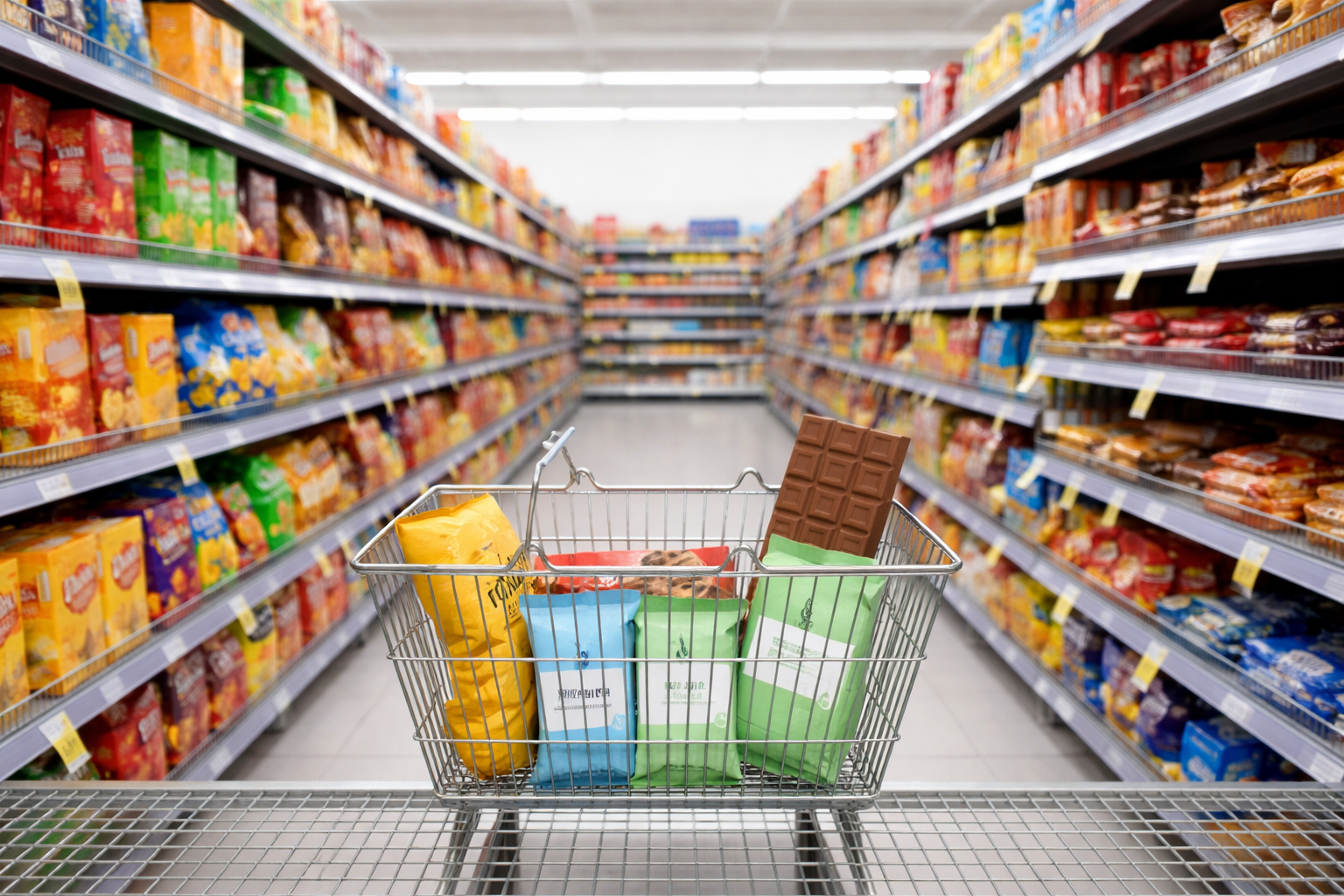
Snacks benefit from an almost die-hard demand driven by human habits, perpetuated by cravings. But now, a slow transition in underway as obese people take to GLP-1 drugs for weight loss. This note looks at how medicine’s effect is shifting the scales for the food industry at large.
A New Challenge for Snack Brands in the Age of Weight Loss Drugs
The snacking market has never had it better. There is a near universal demand for this comforting food – almost a die hard habit that is tough to shake off. And there are numbers to back it up. A Mondelez consumer trend study found that 91% of global consumers have at least one snack daily1. As the craving strikes, people reach out for chips and other types of salty snacks, cookies, chocolates, and even bread. Not surprising then that market research projects this snacks category to grow at a healthy clip of more than 4% CAGR going forward, making it a more than $1 billion market globally in the near future.
In North America, the world’s largest snacking market, PepsiCo recorded a 4% YoY decline in savory snacks volume in 3QFY2025 earnings2. Mondelez International recorded unfavourable volume/mix across all of its regions, with North America down 2.4pp due to soft demand for biscuits & baked snacks and candy, for 9MFY20253. While there are reasons, including inflation impacts, affecting the volume drop for snacks, there is also a more secular change underway. This change is adding some vigour to healthy choices while also holding back the fundamental drivers of snacking — craving, its association with demand and choices, and resultant spending.
GLP-1 Drugs Go Mainstream: Why This Matters for Food Demand
Enter Semaglutide and Liraglutide. Both of these GLP-1 drugs for treatment of type 2 diabetes have shot to fame as research proved their effectiveness for weight loss. These drugs, often the preserve of physicians and patients, have exploded in the public domain to join ranks with the likes of Nano Banana, ChatGPT, iPhone, and Labubu, among others.
What gives? Weight loss is a tough act to follow. It’s a constant battle of will, to follow a regimen of exercise and food choices, pitted against the endless choice of food available to satiate every craving and impulse snacking urge. If this was not challenging enough, weight loss is a slow and hard process, and staying put on the path to it is no less a test of endurance. A weight-loss drug then is the perfect, even ingenious, go-to solution to get results quickly. And when celebrities share weight loss successes from these drugs, it is then only a matter of affordability and less of intent. It is the perfect viral phenomenon, even without social media.
A Cornell SC Johnson College of Business Research paper4 of December 2024 on GLP-1 users reported an average weight loss of 47 pounds, with a median loss of 40 pounds. That is a profound number. And this has led to record sales — combined sales of Ozempic, Wegovy, and Saxenda (all from Novo Nordisk) touched $27 billion in 2024, having generated more than $50 billion since launch5, 6. And this is still not the main story, i.e., Eli Lilly’s Mounjaro and Zepbound, with sales of over $16 billion in 20247, is expected by some to be a top drug for 2025. To top it, analysts at Truist Securities project that Eli Lily’s three medications (including an oral option) could touch $101 billion in peak revenues8.
This only underlines one point — weight loss drugs are here to stay. And they are causing a churn in multiple markets, unexpectedly.
Eating less (and spending less)
Weight loss drugs (also known as Glucagon-like peptide-1 agonists or GLP-1s) are having a profound impact on how much people eat. A national study (current and previous users of GLP-1s) conducted by the Arkansas Agricultural Experiment Station (University of Arkansas)9 found that respondents reporting less consumption of processed foods was about 70% more than those who reported consuming more.
GLP-1s work by reducing appetite and hence craving, resulting in an overall lower consumption. A Sunlight.com10 US survey of 1,200 current GLP-1 users showed a nearly 30% drop in monthly food and diet-related costs (or by $218). It also found a drop in fast food and snack purchases from $183 to $106 (that’s a 42% drop in snacks spending).
A RaboResearch11 report estimated that current GLP-1 usage is already reducing food and beverage consumption by one to two per cent, driven primarily by the US, where adoption is most advanced, and with Europe beginning to follow.
Consumer Behavior Insights: How GLP-1 Users Are Eating Differently
The Arkansas study also highlighted a stark difference in consumption pattern, with 50% more respondents reporting consuming less soda, refined grains and beef than those who reported consuming more of those foods. There were also reductions in the consumption of starchy vegetables, pork, alcohol, fruit juice and dairy milk.
What then were GLP-1 users eating? While the desire for processed food and familiar snacks did not go away, there was a marked shift in favour of fruits, leafy greens and water, the only products showing rising consumption in the Arkansas study.
How big can this be?
According to a Circana research12, US households consuming GLP-1s are projected to account for 35% of all food and beverage units sold by 2030, up from 23% presently. Current research13 estimates that more than 129 million US adults are eligible for Semaglutide weight management. And this is just the US, while the strident march of GLP-1 drugs continues across Europe and Asia. This will unquestionably alter consumption habits, especially those centered around snacking, not to mention its far-reaching impact across multiple sectors. According to RaboResearch, the implications for the food sector are fundamental, representing both disruption and opportunity for the industry. The appetite suppression brought on by GLP-1s is bringing focus on portion-controlled, nutrient-dense foods.
To quote – “People will eat less and growth will hinge on creating more value per bite,” the report says, with “less but better” becoming the norm. “Category impact will vary. Snacks and indulgent staples face sharper disruption, but also stand to gain if they evolve. Dairy, fresh foods and functional beverages are better positioned to benefit.” Forward looking brands that take an early view and retool their snacking and snacks portfolio in light of portion control and nutrient value (such as protein and fiber) stand to take position in a market that can potentially magnify rather quickly.
Strategic Insights: What Snack and Food Brands Should Do?
As we write this, restaurants are feeling the impact and adapting – Otto’s, a London restaurant, has been widely reported to have made changes to the menu to offer small meals and portion control. GLP-1 induced impacts are certain and fundamentally altering consumer behavior when it comes to food and snacks preferences. While the change may be slow and small today, strong public uptake points to a certainty of change. To ensure relevance and growth through this disruption, food brands can leverage a multipoint insights strategy to make early sense of market movements. Tracking research outcomes can add clarity on GLP-1s impact on weight loss, side effects, and dietary needs. With both existing brands and startups keenly eyeing the gap created, competitor insights brings credible insights on new product launches, reformulations, and category changes underway. Broader trend research and category insights will go a long way to know market changes including retailer reactions and government and regulatory moves, which together reduce the surprise element while inducing early action signals.
Eliminate guess work. Embed insights. Indigrowth
1 STATE OF SNACKING, Mondelēz International
https://www.mondelezinternational.com/stateofsnacking/
2 Form 10Q, Q3 2025 PepsiCo Earnings
https://www.pepsico.com/docs/pepsico-5v9wci20/media/Files/investors/q3-2025-form-10q.pdfp
3 Form 10Q, Q3 2025 Mondelez International
https://ir.mondelezinternational.com/static-files/cb7559bd-9dec-46da-94b3-8ecf4fdd0e02
4 GLP-1 adoption and its impact on food demand, Purdue University
https://agribusiness.purdue.edu/2025/03/31/glp-1-adoption-and-its-impact-on-food-demand/
and The No-Hunger Games: How GLP-1 Medication Adoption is Changing Consumer Food Demand, Cornell SC Johnson College of Business Research Paper
https://papers.ssrn.com/sol3/papers.cfm?abstract_id=5073929
5 Novo Nordisk’s 2024 annual report
https://annualreport.novonordisk.com/2024/strategic-aspirations/financials.html
6 Public Citizen
https://www.citizen.org/news/novo-nordisks-50-billion-in-ozempic-wegovy-sales-comes-at-the-expense-of-healthcare-solvency/
7 Eli Lilly Becomes First Trillion-Dollar Health Company, Hematology Advisory
https://www.hematologyadvisor.com/news/eli-lilly-becomes-first-trillion-dollar-health-company
8 Lilly’s Weight Loss Trio Could Top $100B in Revenue Thanks to Oral Option, BioSpace
https://www.biospace.com/business/lillys-weight-loss-trio-could-top-100b-in-revenue-thanks-to-oral-option
9 Characteristics and food consumption for current, previous, and potential consumers of GLP-1s, ScienceDirect
https://www.sciencedirect.com/science/article/pii/S0950329325000825 and https://news.okstate.edu/articles/agriculture/2025/glp-1-food-types.html
10 Survey Finds: GLP-1 Users Cut Food Costs Nearly 30%, Sunlight
https://www.sunlight.com/news/survey-finds-glp-1-drugs-cut-food-costs-nearly-30/
11 “Every bite counts” – GLP-1 weight loss medicines and the future of food, Rabobank
https://www.rabobank.co.nz/media-releases/2025/25112025-every-bite-counts-gpl-1-weight-loss-medicines-and-the-future-of-food
12 GLP-1 Medication Users to Represent 35% of U.S. Food and Beverage Sales by 2030, New Circana Research Reveals, Circana
https://www.circana.com/post/glp-1-medication-users-to-represent-35-percent-of-u-s-food-and-beverage-sales-by-2030
13 Semaglutide Eligibility Across All Current Indications for US Adults, JAMA Cardiology
https://jamanetwork.com/journals/jamacardiology/fullarticle/2826358